

For the first time in decades, Vancouver Island residents won’t be turning their clocks back this weekend, and it’s going to create some interesting differences with our neighbours.
Starting Sunday, November 1st, British Columbia will officially remain on permanent daylight saving time, meaning residents in Greater Victoria and most of the province will no longer have to “spring forward” or “fall back.”
The change follows the provincial government’s decision earlier this year to eliminate seasonal clock changes, keeping most of BC on UTC-7 year-round under the new Pacific Time (PCT) designation.
But while that means no more changing the clocks twice a year, it also means the time difference between BC and several familiar destinations is about to look a little different.
And some of those changes might surprise you.
Seattle will now be one hour behind BC
This is probably the biggest adjustment for Vancouver Island residents.
For years, Victoria, Vancouver and Seattle have shared the same time throughout the year.
That’s about to change when Washington state turns its clocks back on Sunday, Seattle will become one hour behind Victoria.
That means when it’s 12 p.m. in Victoria, it’ll only be 11 a.m. in Seattle.
The same will apply to Portland, Oregon and cities throughout California, including Los Angeles and San Francisco.
The difference will remain until March 2027, when those states return to daylight saving time.
For anyone travelling across the border, catching a flight or watching an event south of the border, it’s something worth keeping in mind.
Heading to Las Vegas? You’ll now be an hour ahead
For BC residents planning a winter getaway to Las Vegas, there’s another change worth knowing about.
For years, Victoria and Las Vegas have shared the same time throughout the year.
But starting Sunday, November 1st, ‘Sin City’ will be one hour behind Vancouver Island.
That means when it’s noon in Victoria, it’ll only be 11 a.m. in Las Vegas.
Interestingly, Phoenix, Arizona will remain on exactly the same time as Victoria throughout the year.
That’s because most of Arizona already avoids seasonal clock changes, making it one of the few American destinations that will stay perfectly synchronized with Vancouver Island.
Other popular destinations will also see their winter time differences shrink. New York, Orlando and Miami will be just two hours ahead of Victoria instead of the usual three.
Meanwhile, Denver and Salt Lake City will share the same time as Victoria during the winter months, despite traditionally being one hour ahead.
For travellers booking flights, planning vacations or watching sporting events, the changes are worth keeping in mind.
What about Alberta, Saskatchewan and Manitoba?
BC isn’t the only province saying goodbye to seasonal clock changes.
Alberta is also adopting permanent daylight saving time, keeping Calgary and Edmonton one hour ahead of Victoria year-round.
Saskatchewan, which already avoids seasonal clock changes, will also remain one hour ahead of Vancouver Island throughout the year.
Meanwhile, Manitoba is making the switch to permanent daylight saving time, meaning Winnipeg will stay two hours ahead of Victoria year-round instead of moving three hours ahead during the winter.
That means when it’s noon in Victoria, it’ll be 1 p.m. in Calgary and Regina, and 2 p.m. in Winnipeg.
Toronto will be just two hours ahead during winter
One of the more noticeable changes for anyone with family or business connections in eastern Canada will involve Ontario.
Toronto and Ottawa will continue changing their clocks twice a year.
That means the traditional three-hour difference between Victoria and Toronto will shrink to just two hours during the winter months.
When it’s 9 a.m. in Victoria, it’ll be 11 a.m. in Toronto rather than noon.
The three-hour difference will return when Ontario springs forward in March.
What about the rest of Canada?
The changes create a patchwork of time differences across the country. Yukon will remain on the same time as Victoria throughout the year, while Quebec will follow the same pattern as Ontario.
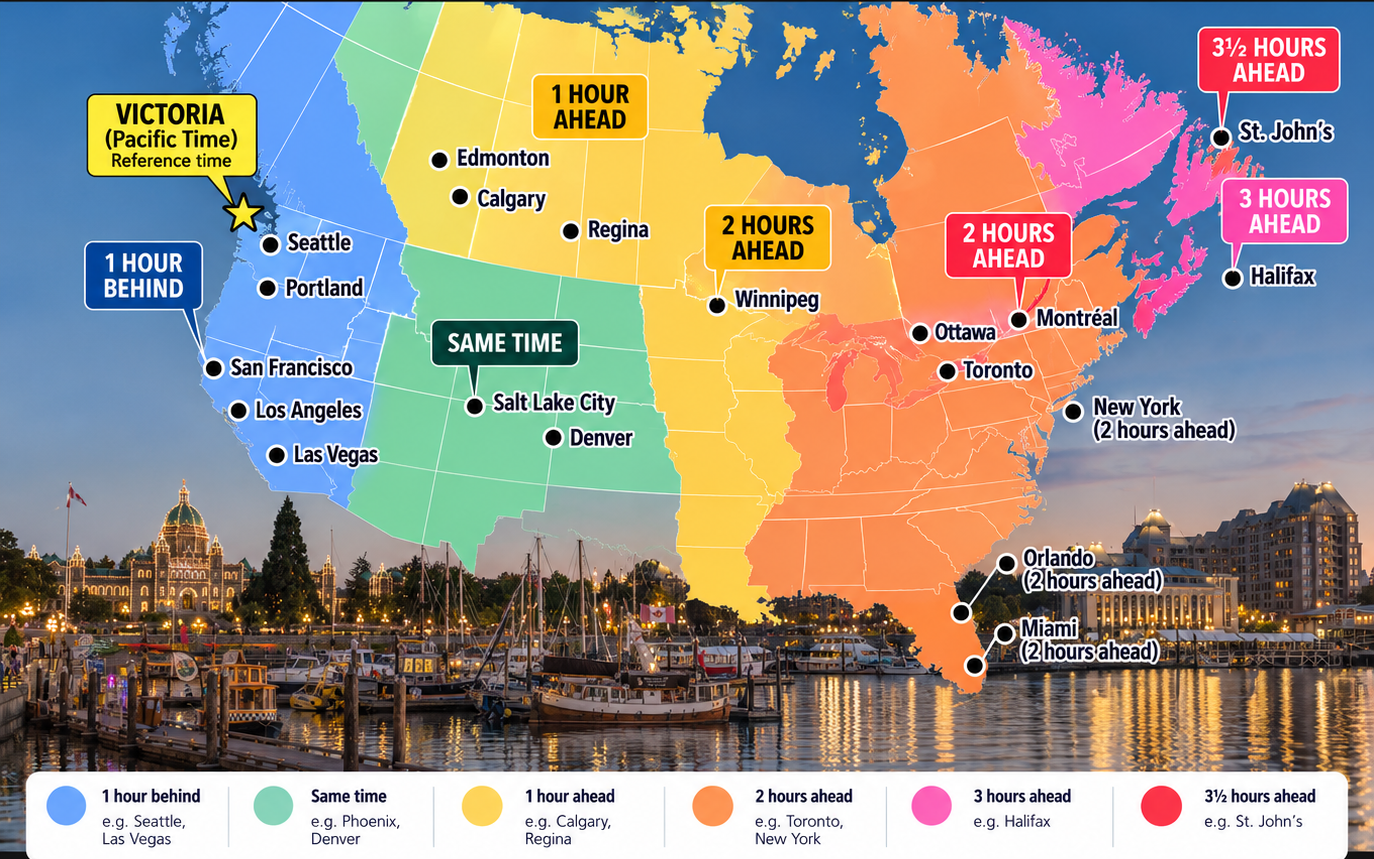
The Maritime provinces will move from four hours ahead of Victoria in the summer to three hours ahead in the winter.
Newfoundland will move from four and a half hours ahead to three and a half hours ahead.
While Vancouver Island residents won’t have to worry about changing their clocks anymore, the new time differences may take some getting used to.
Anyone travelling or connecting with people outside BC will want to double-check the time, especially with Victoria now one hour ahead of Seattle and just two hours behind Toronto during the winter.
Welcome to the new world of time zones!
💬 Join the conversation
No comments yet — be the first to start the conversation