

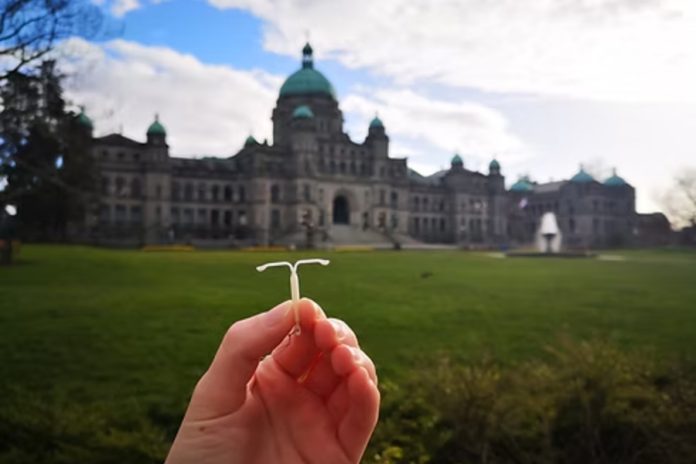
Local advocacy group for improved access to healthcare, AccessBC, is celebrating the third anniversary of prescription contraception becoming free in British Columbia.
The grassroots campaign chaired by Saanich Councillor Teale Phelps Bondaroff says that the push for free access to contraception has benefitted over 400,000 people thus far.
Though the move by the BC government to implement a free prescription contraception policy was historic, as it was the first of its kind in Canada, AccessBC would like to see the Province make further improvements to reproductive justice issues.
“Free prescription contraception has helped transform lives and improve the health and well-being of hundreds of thousands of British Columbians, and I am so proud that our province has become a beacon of hope for reproductive justice at a time when such hope is desperately needed,” said Teale Phelps Bondaroff, AccessBC campaign chair and co-founder.
“The increased use of prescription contraception after the policy took effect makes it clear — cost was a major barrier preventing access to this life-saving and life-changing medicine. By removing this barrier, we empower people to access the medicine they need to exercise reproductive autonomy.”
BC became Canada’s first province or territory to implement universal, free coverage for free prescription contraception on April 1st, 2023.
The Province dedicated $119 million over three years for the program that covers some oral pills, injections, hormonal rings, copper and hormonal intrauterine devices (IUDs), implants and Plan B — an emergency contraception that is also known as the morning after pill.
Though many contraceptive methods are covered by BC’s policy, some are not. Some name brands of contraceptive pills that are not fully covered are Alesse, Marvelon, Min-Ovral, Yasmin and Yaz.
Prior to this legislation, cost was a major barrier for some. AccessBC says that a hormonal IUD can cost more than $500, a contraceptive implant costs $350, oral contraceptive pills cost at least $240 per year and hormonal injections as much as $180 per year.
The advocacy group noted that in addition to helping prevent unintended pregnancies, contraceptive medications can help with medical issues, such as treating chronic pelvic pain, ovarian cysts, endometriosis, heavy menstrual bleeding, irregular cycles, hormonal acne, cyclical mood changes and gender-affirming care.
Between April, 2023, and February 28th, 2026, the BC Ministry of Health reported that 407,000 people were able to access prescription contraceptives at no cost.
Another milestone for free contraceptives in BC came with the federal government passing the Pharmacare Act (Bill C-64), which was championed by the NDP and made the cost coverage a federal responsibility.
However, thus far, only BC, Manitoba, Yukon and Prince Edward Island have signed on with the Pharmacare Act. This lack of access brings a renewed concern to AccessBC.
While the policy has been a massive success in BC, efforts to see the roll out of universal no-cost prescription contraception across Canada appear to have stalled.
Currently, only 17% of the Canadian population is covered by the Pharmacare Act.
“The success of BC’s free prescription contraception program throws into stark contrast a growing inequality across Canada, where someone’s access to this life-saving and life-changing medication now depends both on their income and their postal code,” Phelps Bondaroff explained.
“As we celebrate the 3rd anniversary of free prescription contraception in BC, we are calling on the federal government to show leadership on this issue and get back to negotiating Pharmacare agreements with outstanding jurisdictions across the country.”
The Saanich councillor added that someone’s ability to exercise reproductive autonomy should not depend on their income or postal code.
💬 Join the conversation
No comments yet — be the first to start the conversation