

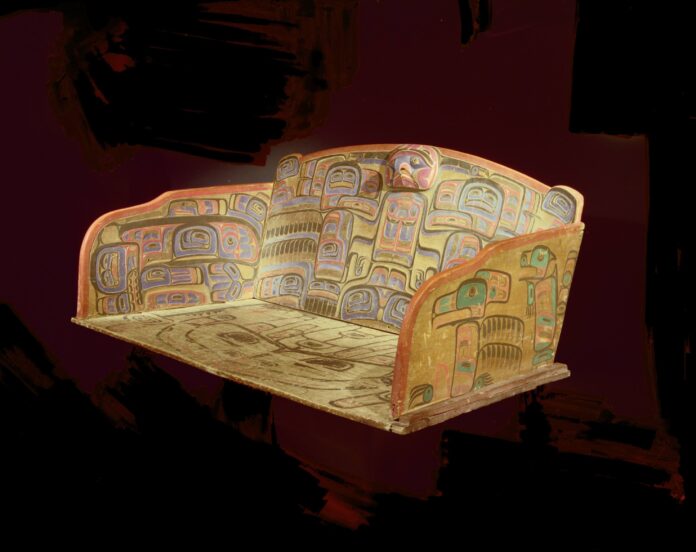
On Friday, July 12th, the Royal BC Museum (RBCM) returned an elaborately carved and decorated chief’s seat to the Heiltsuk Nation.
This move is being celebrated as the first step of the repatriation by the museum.
A ceremony was held at the RBCM in which Heiltsuk chiefs and council members, family members and dancers gathered to bless and receive the seat.
The seat was carved by Captain Richard Carpenter, who the Nation says was a pre-eminent Heiltsuk artist, carver and canoe and boat builder. He lived from 1841 to 1931 and has works on display in museums around the world.
His traditional name Heiltsuk was Hiwallis; however, because of colonialism, he was assigned the name ‘Carpenter’ during the 1881 census because he was so well known for his woodworking.
This chief’s seat came into RBCM’s possession in 1911.
“The repatriation of the chief’s seat, is a powerful and emotional moment for our family and the Heiltsuk Nation,” said Marilyn Slett, a descendent of Captain Carpenter and the elected Chief of the Heiltsuk Nation.
“Hawallis’s artwork has been on display in museums and collections around the world, from Berlin and London to Alaska and New York. This is the first of his treasures to return home, so that we can all enjoy and benefit from his work.”
She added that she is thankful to the RBCM for their proactive approach to repatriation.
Elizabeth Vickery, Vice President of Strategic Operations at the RBCM says they are making their best effort towards “a Nation-led approach to repatriation.”
“We are excited to see the Chief’s seat returned home and look forward to continuing this work with the Nation,” explained Vickery.
Related:
According to the Heiltsuk First Nation, Captain Carpenter was a master woodworker and chief who lived to the age of 90.
Through his art, he told stories of his life and his people, actively stewarding Heiltsuk society and culture, including the massive changes wrought by colonialism, decimation by smallpox and the subsequent resurgence of Heiltsuk culture and society.
His work included traditional regalia, bentwood boxes for people of high status and monumental canoes, among others.
The Nation says one such piece of work was a 75-foot-long canoe built and gifted to Chief Shakes of Kitkatla. This piece was later sold to collectors and brought to the United States, where it now collects dust at the American Museum of Natural History in New York.
“Captain Carpenter always stressed the communal organization and mutual support amongst Heiltsuk people, as he witnessed massive historical change and guided our people through it,” said Chief Slett.
“He helped to continuously remake Heiltsuk society as we adapted, in the same way that he incorporated new and innovative elements into traditional Heiltsuk arts and style. His artistic and cultural legacy reminds us that we, the Heiltsuk people, are the masters of honouring and reinventing our culture and art, and our place in the world at the same time.”
The chief’s seat is one of Captain Carpenter’s most ornate works and will be returned to their new ceremonial Big House in Bella Bella following today’s ceremony.
This is the second monumental return of Indigenous artifacts by the RBCM to occur in the last two years.
In February, 2023, a totem pole was returned to the Nuxalk Nation.