
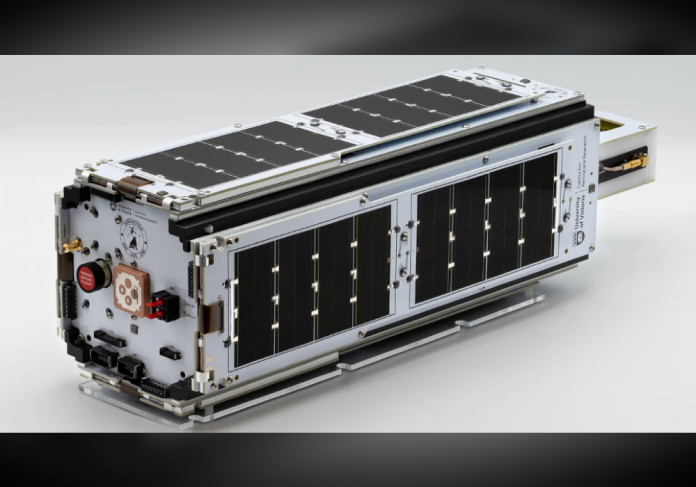
This summer, students and researchers at UVic will be sending a miniature satellite into space to collect data on the impacts of climate change.
The project is being led by UVic’s CubeSats Initiative in Canada for STEM (CUBICS) team, who are reportedly on track to launch the satellite in July.
The team’s research has recently been integrated by the Canadian Space Agency, in order to place their satellite, MARMOTSat, into its deployment module and officially clearing it for launch.
MARMOTSat (Mission for Atmospheric Radio Measurements with Open-source Technology Satellite) is a shoebox-sized satellite known as a CubeSat, measuring just 340 millimetres long by 100 millimetres tall and wide.
The purpose of the satellite is to be placed in low earth orbit to collect ionospheric data to better understand links between human-caused climate change and the composition of the ionosphere.
The data collected will allow UVic to continue to train students in space science and technology and facilitate new research into the correlation between the ionosphere’s composition and structure.
Currently, MARMOTSat is undergoing assembly, integration and testing of flight systems.
It will launch on Transporter 17 from Vandenberg Space Force Base, California, in July.
Through the nationwide CUBICS program, UVic received a grant of $349,600 for the MARMOTSat project. Eight other universities across Canada received similar grant funding for their mini-satellite projects.
💬 Join the conversation
No comments yet — be the first to start the conversation