


Southern resident killer whales, such as those that frequent the waters off Vancouver Island, have recently been observed making and using tools to socialize and clean themselves.
By using drone technology, researchers were able to collect evidence of the widespread manufacture and use of ‘allogrooming’ tools in a particular population of southern resident killer whales.
Allogrooming refers to a form of social grooming, which in this case, involved the whales who fashioned short lengths of bull kelp from complete stalks, then positioned the ‘stipe’ between themselves and a partner and finally, they rolled the kelp along their bodies.
This behaviour was observed, and recorded in a study, led by Michael Weiss, Research Director at the Center for Whale Research, and it was published in Current Biology, a scientific journal.
Weiss and his team observed a group of southern resident killer whales occupying waters in the central Salish Sea from April 10th to July 27th, of last year.
According to Weiss’ study, whales are often observed draping kelp over their bodies—this behaviour is referred to as “kelping.”
However, the discovery of this new behaviour is exciting because it has never been seen before, and now researchers must determine whether this is a new trend amongst the southern residents, or if it is an elaboration on kelping that just hasn’t been observed before.
This new behaviour is called “allokelping.”
While observing the whales, Weiss’ team witnessed 30 instances of this newly discovered behaviour amongst three separate southern resident pods.
“Whales fashion lengths of kelp stipe for allokelping by using their teeth to grab a kelp stalk by the narrow end of the stipe near the holdfast,” wrote Weiss and his team in their report.
“They then use the kelp’s drag, the motion of their body and their teeth to separate a short length of the kelp stipe.”
From there, Weiss describes the two whales pressing the kelp stipe between their flank and their head, maneuvering the kelp while rolling it between their bodies.
“Whales maintained continuous contact for a median of 32 seconds during allokelping,” stated Weiss.
“During contact, whales roll and twist their bodies, often adopting an exaggerated S-shaped posture.”
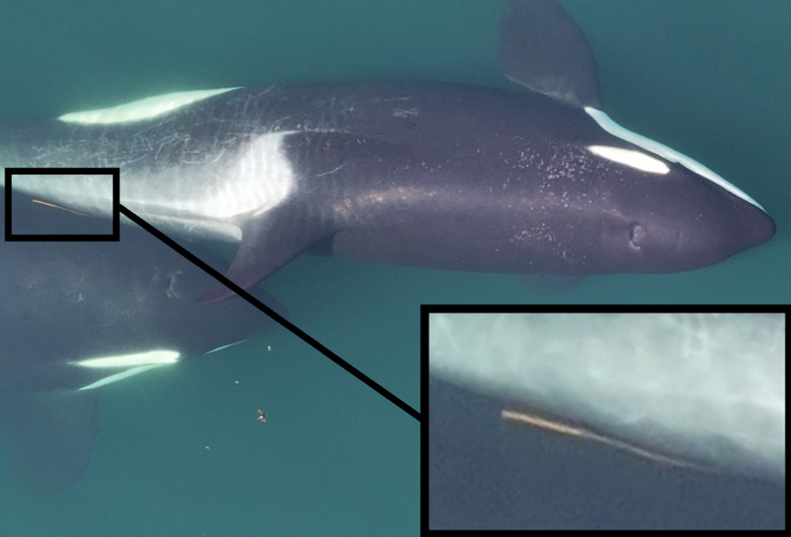
Following the interaction, most whales observed would retrieve the kelp stipe and re-initiate the interaction.
Because of the unique way this interaction was observed and the demographics between the whales, researchers do not believe this to be a form of play, which needed to be ruled out for them to land on their theory that this was actually a form of allogrooming.
“We hypothesize that allokelping is a cultural behavior unique to southern resident killer whales,” explained Weiss.
“Future work should investigate if and how allokelping is learned, and whether it occurs in other killer whale societies.”
Weiss added that the southern resident killer whale is a critically endangered species, with only 73 of the whales remaining in the world, according to the latest data from the WWF.
💬 Join the conversation
No comments yet — be the first to start the conversation