

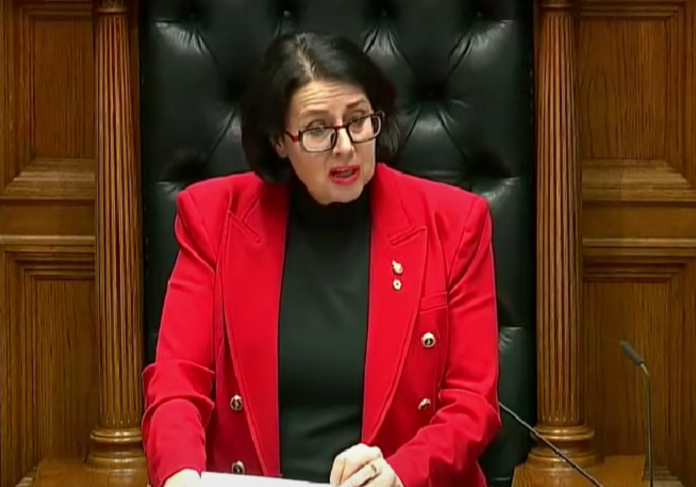
With the provincial election eight months away, today’s throne speech served as both an early election platform and promises on improving the economy, housing and getting more doctors to work in the province.
On Tuesday, February 20th, the Legislative Assembly of British Columbia opened its spring session with a throne speech.
Land acknowledgements, a song and a blessing were performed by the Songhees First Nation’s Elder Butch Dick, Speaker Raj Chouhan, the Esquimalt First Nation’s Elder Marianne Thomas and Rabbi Harry Brechner.
Following this introduction, Lieutenant Governor Jane Austin arrived in the company of the Lekwungen Dancers and Singers and allowed them to perform before she took the Speaker’s podium to deliver her speech on behalf of the throne.
She gave her own land acknowledgement, thanked those who opened the session and gave an in memoriam for some prominent figures who have passed away recently.
From there, she spoke to the successes that the government has achieved recently, such as its record-low unemployment, with an emphasis on a record-high for job equity for women in the workplace.
“[This is] further proof that increasing wages and lowering child care bills is better for families and good for businesses,” Lieutenant Governor Austin said.
Austin says that over 250,000 people have found employment thanks to Province-funded job training and access to child care.
“That’s why action will be taken this session, to further break down barriers for those who can work while your government continues to support those who cannot,” she continued.
Austin says she is optimistic for the future as industries begin to reemerge after the pandemic, such as tourism, with the Invictus Games, FIFA Men’s World Cup and Grey Cup all taking place in Vancouver soon and film crews returning to BC.
“Hollywood North is back,” Austin exclaimed.
However she also lamented that the government is working hard to improve economic conditions for all.
“Too many people are not feeling it yet, too many people are struggling to get ahead,” said Lieutenant Governor Austin.
“After decades where our housing market was able to serve the interests of investors and speculators, even those with a middle-class income are finding it hard to afford a home.”
She spoke of the anxieties British Columbians are feeling over high interest rates, inflation, grocery prices, online dangers, affordable living and more.
Lieutenant Governor Austin tried to give reassurance to those feeling this way.
“[Your government] will have your back, so you are not facing these new challenges alone because leaving people to fend for themselves does not work,” she said.
“It did not work before and it will not work now and it would mean deep cuts to the services we rely on.”
The specific government programs that were spoken of included BC Builds, the most recent and lofty goal set by the Province to get more homes built for middle-class families.
“Housing costs went up, and in recent years the combination of inflation, interest rate hikes and a lack of supply has only made the situation harder for people looking to buy or rent a home,” said Austin.
“This is a generational challenge and we must meet the moment.”
She also spoke of incoming changes coming for British Columbians and small businesses that may help with increasing costs of living and operating a business.
They are also attempting to continue to lure more family doctors to BC in order to be able to provide better health care.
“BC is building more hospitals, primary care centres, cancer clinics and care homes closer to where you live, through the largest health care capital strategy in the Province’s history,” Austin said.
She also pointed out that BC will be the new home to the first new medical school in the province in over 50 years at Simon Fraser University’s Surrey campus to train new family doctors.
When it comes to natural resources and climate, Lieutenant Governor Austin says the government will be focussing on shifting to clean jobs while increasing protections for BC’s climate.
She especially noted the importance of preparing for increased frequencies of climate emergencies and wildfires.
“The cost of inaction is simply too high,” explained Austin.
“It is our homes and communities in the paths of wildfires, it is our crops or our farms that are at risk of drought, it is our kids and grandkids who stand to lose the nature that surrounds them.”
“We are expecting another tough drought and wildfire season this summer,” she continued.
As for safety, Austin said that keeping kids and communities safe are of utmost importance to the BC government.
She specified that new legislation will be introduced to protect schools from “disruptive protests” and it will continue to attempt to hold social media companies accountable for the harm that is caused to BC’s youth on their platforms.
Austin also spoke of new anti-racism legislation, specifically a mandate that all schools will have to teach about the Holocaust.
Although she mentioned that this new legislation would extend to try to curb Islamophobia, she made no mention of any specific tactic.
On that note, throughout the entirety of the throne speech, protesters were gathered outside the legislature advocating for peace in Palestine and for the government to better acknowledge their indifference toward the genocide currently taking place.
One individual even devoted her Family Day long weekend to a hunger strike at the BC legislature, anticipating that the throne speech would not include any content related to the ongoing situation in Palestine.

Lieutenant Governor Austin closed her throne speech by saying that coming together is the best way for BC to move forward.
“Your government is committed to rejecting division and working to bring people together to solve problems, because here in BC, our best days are still ahead of us,” she said.
“If we work together, this will be a place where everyone can build a good life—whether you live in a city, a town, a rural or a First Nations community.”
“Where the wages of working people go up, but the cost of a decent home does not; where we have more family doctors and shorter wait times in emergency rooms; where our economy grows, not in spite of climate action, but because of it; where our kids are safe in their communities, schools and online; where everyone belongs, everyone can get ahead and no one gets left behind—that is the vision your government is working on every day to deliver.”