A group at the University of Victoria has moved one step closer to creating a feat of underwater engineering.
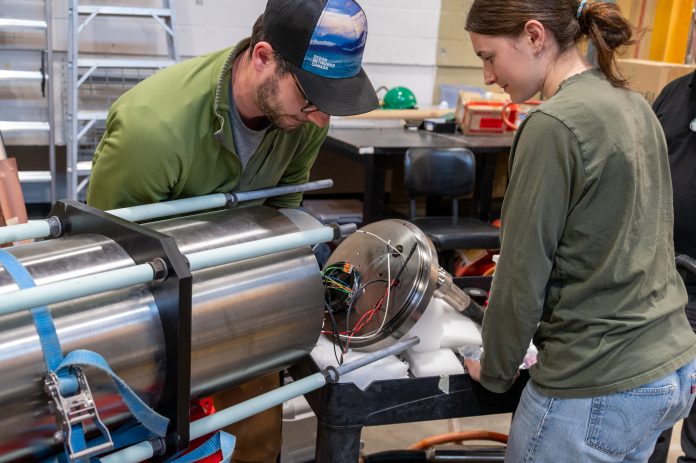
Ocean Networks Canada (ONC), a UVIC initiative, partnered with Pacific Ocean Neutrino Experiment (P-ONE) to successfully complete a shallow-water test of key engineering infrastructure on Granville Island.
The goal of the test was to support the creation of a P-ONE telescope.
UVic says the telescope’s objective will be to study neutrinos in the pitch black deep-sea environment, with the aim of helping scientists get a glimpse of the universe from under the sea.
Scientists believe that neutrinos particles are cosmic messengers that can help them better understand the history of the universe.
The testing marks a major milestone in the development of the telescope and comes ahead of the planned deployment of the first one-kilometre-long subsea mooring off the coast of British Columbia later this year.
The project is a collaboration between groups from Canada, Germany, Poland, the United Kingdom and the United States, with plans to eventually install 70 one-kilometre-long moorings, spaced 80 metres apart in the area.
The moorings will be equipped with scientific instruments extending up from the seafloor, and the P-ONE telescope will eventually be plugged into ONC’s NEPTUNE observatory at UVic, helping ONC monitor and study neutrinos in the deep-sea environment.
Data from the telescope will be shared with P-ONE partners, while oceanographic and marine-life data will be openly accessible to the public.
UVic’s ONC initiative is one of Canada’s six Major Research Facilities, operating world-leading observatories in the deep ocean and coastal waters of the Pacific, Atlantic and Arctic coasts of Canada, as well as the southern ocean.
The organization also operates mobile and land-based assets, including coastal radar.
Work done by ONC helps generate data, including video and underwater sound recordings, which is used by researchers, communities and decision makers around the world.
💬 Join the conversation
No comments yet — be the first to start the conversation