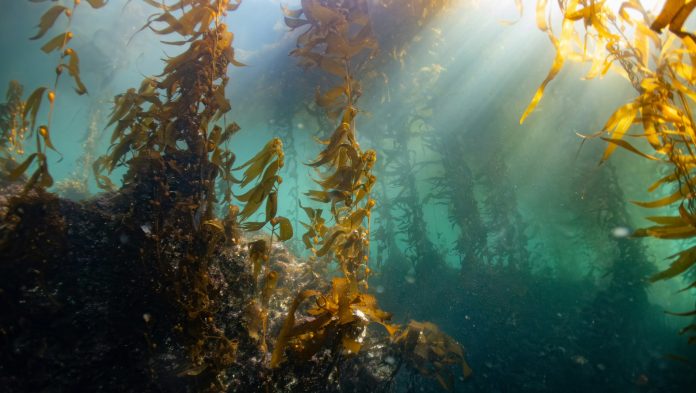
New research from the University of Victoria has revealed that kelp forests around Vancouver Island started disappearing far earlier than scientists previously thought.
The discovery highlights the fact that climate change has been altering our ecosystems for longer than most people have been aware of the problem, the report said.
“Most research has focused on recent kelp forest losses resulting from well-known marine heatwaves, like the record-breaking ‘Blob’ heatwave that hit our coast a decade ago,” said Brian Timmer, lead author of the study recently published in Ecological Applications.
The study compared baselines for bull kelp and associated macroalgae communities in the northern Salish Sea using maps, aerial photos and scuba surveys from as far back as 1972 to identical surveys and photos in 2023.
The purpose was to find the difference in kelp forest size and abundance over the last 50 years.
“These recent changes to our kelp forests have been intense,” said Chris Neufeld, co-author and senior aquatic ecologist at LGL Limited.
“Our research shows that some areas of the BC coast have been warming much faster than the global average, and associated kelp declines began decades ago. We’ve been underestimating the magnitude of ocean-warming impacts for years.”
Historical records showed that there used to be massive bull kelp forests floating at the surface, covering more than 550 hectares of the sea near Comox and Denman Island. These records increased the previous baseline of kelp forests by a factor of 10.
Unfortunately, none of those forests remain today.
Satellite records show that most of the loss occurred between 1972 and 1984. This is well before kelp losses were documented during more recent marine heatwaves.
Timmer’s research also showed that climate change was a driving factor behind much of the loss of these kelp forests by using historical temperature data from Salish Sea lighthouses and determining that by the time the kelp had disappeared in the late 70s, the sea was substantially warmer than it had been in the early 1900s.
Temperatures have continued to climb, making conditions even worse now than they were since the initial devastating losses, the news release explained.
Timmer’s study found that under the surface of the water, cold-adapted species of kelp and red algae had declined between 60% to 99%, as the decline was particularly strong in shallow water. When cold-adapted species died off, they were not replaced by warm-water species.
The result of this is significant habitat loss and reduced food availability for coastal species like herring, rockfish and salmon.
“We’ve been living with a completely warped sense of what ‘normal’ oceans look like,” Timmer said.
“What we previously thought of as a baseline for the extent of our kelp forests was already post-collapse.”
Timmer went on to explain that their research shows how important baselines are when investigating the impact of climate change.
These baselines help researchers, scientists and others to make informed decisions about conservation, restoration and climate action before more irreversible damage occurs.
Kelp forests are integral to coastal ecosystems. They provide habitat and food for fish, which supports fisheries, protects shorelines and contributes to cultural and economic wellbeing.
The study was funded by Fishers and Oceans Canada, the Natural Sciences and Engineering Research Council, the National Geographic Society and the Royal Canadian Geographic Society’s Trebek Initiative.
💬 Join the conversation
No comments yet — be the first to start the conversation