Today Prime Minister Mark Carney’s government released their Budget 2025, the first fiscal plan since Carney took office.
There are many factors in Budget 2025 in which the government shows its prowess on the global scale, including matters of gross domestic product (GDP), investments and expenditures, but the plan also focuses heavily on a plan shifting spending away from public services.
Here are five key factors from the budget that could impact Canadians if the fiscal plan is approved:
Canada’s deficit
A deficit refers to the amount of money spent by the government beyond its revenues, and Budget 2025 is projecting a national deficit of $78 billion in the 2025-26 fiscal year.
However, their plan outlined in Budget 2025 aims to bring this figure down to $57 billion by 2029-30.
The projected $78 billion has come as a surprise to many critics because in 2024, the fall economic statement released by the Canadian government only projected a deficit of $42 billion.
This estimate in the fall economic statement was issued before President Donald Trump began to announce tariffs against Canada, and the feds say the ongoing trade war with the United States is to blame for the extra spending.
Generational shifts
According to Budget 2025, the world is currently undergoing a shift that has not been seen since the Berlin Wall came down.
This is largely due to Trump single-handedly shifting the way international trade is being conducted and threatening Canada’s sovereignty.
“This is not a transition,” reads Budget 2025. “It is a rupture—a generational shift taking place over a short period of time.”
According to the Canadian government, these generational shifts are creating or exacerbating current economic challenges across the country.
Some of these challenges include a high cost of living, increased unemployment, businesses facing uncertainty, slowed global economic growth, weakened productivity and lower oil prices.
Investing rather than spending on services
Carney’s government plans to cut spending on operational expenses that include social services Canadians rely on, and instead, spend more on capital investments.
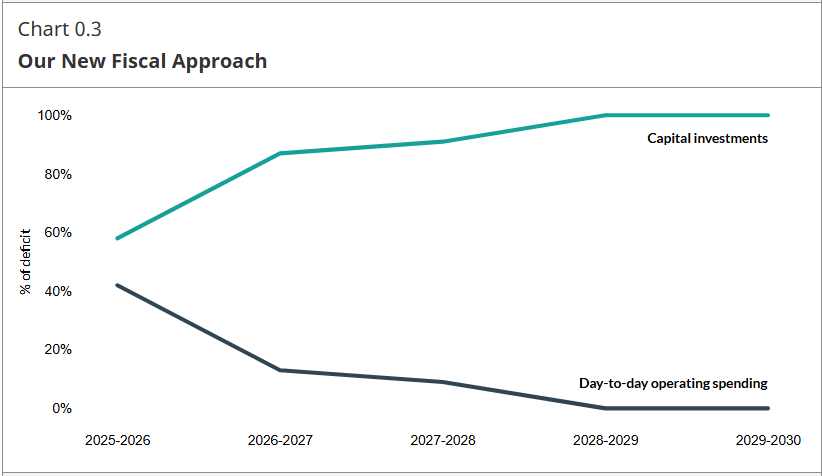
The Budget says it will prioritize rightsizing, cutting red tape, cutting wasteful spending and adopting AI at scale.
To achieve this, the government will be cutting operational spending across the board, which could mean cutting jobs.
Budget 2025 says that the government will slow growth in program spending from 8% to under 1%.
Additionally, in order to adopt AI systems across all levels of government, a new Office of Digital Transformation will be created.
Expenditure review
Budget 2025 includes a Comprehensive Expenditure Review, which aims to save $60 billion over the next five years.
According to Carney’s government, this will be achieved by “reducing inefficiency and focusing on core priorities.”
Some measures being taken will include restructuring operations, consolidating internal services and rightsizing programs.
Part of this plan is to adjust the workforce to return the size of the federal public service to a more sustainable level.
This means cutting jobs in the public service.
“The government understands that transitions can be difficult and is committed to minimising hardship for federal employees, while also protecting diversity in the public service workforce and ensuring a strong, younger generation of public servants,” reads Budget 2025.
“This is a transformational time for the public service to revisit how we work, how we can improve services to Canadians, and how we can build for the future.”
Generational investments
Budget 2025 includes figures on how much the federal government intends to spend on matters of importance to maintain funding for Canada’s continued growth.
According to the budget, $25 billion will be spent on housing initiatives over the next five years, $30 billion will be spent on defence, $115 billion will be spent on infrastructure and $110 billion will be spent on productivity and competitiveness.
“Canada stands at a crossroads,” reads the fiscal plan. “This is the moment to move from reliance to resilience.”
“The global shocks we have endured demand more than short-term fixes; they call for a bold down payment on the prosperity of the next generation.”
This notion of resilience ties into the main theme of Budget 2025: Building Canada Strong.
The budget was only revealed today, but will not be implemented until it is passed by Canada’s parliament.
However, Carney’s Liberal government is shy of a majority, which means they will need support from other parties to enact its fiscal plan.
Click here to see the full Budget 2025.