
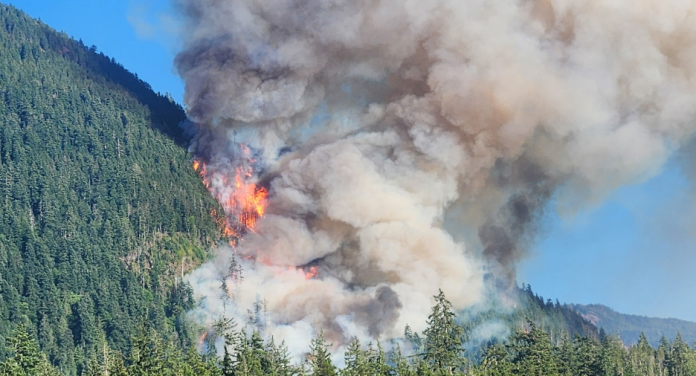
While some areas of BC experienced heavy damage due to widespread wildfires, a recent update indicates 2025 was not as destructive as past years.
The season started with dry conditions that saw fires pop up throughout BC, but thanks to favourable weather conditions and some other variables, there was a significant decrease in mid-summer wildfire activity, provincially.
However, from mid-August to early September, BC saw a resurgence of wildfire activity despite widespread precipitation.
BC Wildfire Service (BCWS) says that this late-season activity was driven by above-seasonal temperatures, lightning activity and regional drought conditions.
Due to these factors, BCWS says that the traditional “core wildfire season” is a thing of the past.
This year, Vancouver Island experienced its second largest wildfire in recorded history, the Mount Underwood wildfire, which spanned 3,671 hectares at its peak.
This blaze was deemed one of 2025’s most notable wildfires of the year, along with BC’s largest wildfire of the year, the Pocket Knife Creek wildfire, which burned 149,505 hectares of land.
Beginning April 1st, the 2025 BC wildfire season saw more than 1,350 fires which burned an estimated 886,360 hectares of land.
Of the last six wildfire seasons, 2025 ranks fifth most severe. Below are the stats for the five years preceding 2025’s wildfire season.
- 2024: 1,697 wildfires – 1,081,159 hectares burned
- 2023: 2,293 wildfires – 2,840,104 hectares burned
- 2022: 1,801 wildfires – 135,235 hectares burned
- 2021: 1,647 wildfires – 869,300 hectares burned
- 2020: 670 wildfires – 14,536 hectares burned
In 2025, wildfires resulted in 42 evacuation orders, which affected approximately 2,600 properties. Additionally, 91 evacuation alerts were issued, affecting approximately 6,950 properties.
Though this year did not set records in terms of wildfire numbers or hectares burned, BCWS did set a new record for most applicants during their recruitment process.
As of November 1st, the estimated cost of wildfire suppression this year was $510 million, which is less than the $778 million that was set aside in their Budget 2025/26.
National wildfire symposium
Though 2025’s wildfire season was not BC’s most severe, it was determined to be the second worst season across Canada.
This wildfire season, Saskatchewan and Manitoba were hit hardest.
Saskatchewan reportedly accounted for approximately 2.73 million hectares burned, while in Manitoba, around 1.73 million hectares were burned.
Together, these two provinces made up more than half of Canada’s total area burned this year.
In comparison, British Columbia saw only around 886,360 hectares burned in 2025.
Because of the severity of this past season, BC has opted to host a national wildfire symposium to discuss enhancing a national wildfire framework, address challenges certain communities are facing and explore new technologies that might help reduce impacts of wildfires in Canada.
“As wildfire seasons become more severe and complex, it’s paramount that we co-ordinate our national response capabilities to protect the safety, health and economic well-being of communities from coast to coast to coast,” said Ravi Parmar, Minister of Forests.
“In order to meet these challenges head on, BC is taking initiative by creating the opportunity for leaders and experts to come together, reflect on lessons learned and shape the path forward to help keep people throughout Canada safe.”
For this symposium, experts, provincial, federal and territorial governments as well as key industry and Indigenous partners will come together with the goal of looking forward to the 2026 season.
The upcoming wildfire symposium will be held in Vancouver on December 5th.