

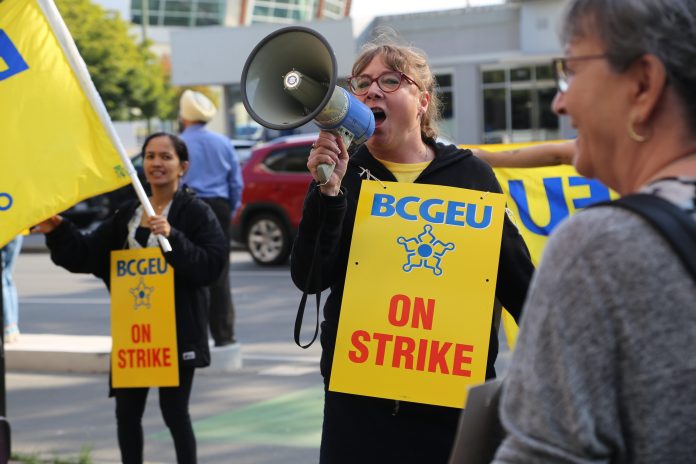
With the BC Public Service strike now on its third day, the BC General Employees’ Union (BCGEU) has decided to escalate the ongoing job action.
BCGEU is establishing additional picket lines at key sites throughout BC in order to put pressure on the Province of BC’s Public Service Agency (PSA)—the employer in the negotiations—to return to the negotiating table.
On Thursday, September 4th, picket lines expanded to include 90 BCGEU workers on strike in front of the Ministry of Finance building in downtown Vancouver.
This picket line is in addition to the near 2,600 workers on strike at key government sites in Victoria, Surrey and Prince George.
In Victoria there are seven picket lines established, including at 3350 Douglas Street, 4000 Seymour Place, 1802 Douglas Street, 1810 Blanshard Street, 836 Yates Street, 675 Belleville Street and 716 Courtney Street.
“BCGEU members in the public service deliver the essential services British Columbians depend on every day, and they deserve wages that reflect the value of the critical work done by workers including wildfire fighters, social workers and court clerks,” said Paul Finch, BCGEU president and chair of the Public Service Bargaining Committee.
“The employer’s refusal to put forward a wage proposal that meaningfully addresses the affordability crisis leaves us no choice but to escalate job action.”
The union’s BC Public Service bargaining unit is one of the largest in the province, consisting of over 34,000 members.
These members include around 2,000 BC Wildfire Service workers, 2,350 correctional officers and sheriffs, 4,850 liquor and cannabis retail and distribution staff, 3,600 Ministry of Children and Family Development workers as well as over 14,000 administrative professionals working in ministries and departments across the provincial government.
The above BCGEU members are calling for a wage package that keeps pace with the rising cost of living and recognizes their vital contributions to the province.
Specifically, some of the key issues BCGEU is fighting for in this negotiation are more competitive wages to combat the affordability crisis, fair access to telework, and a modernized contract with a classification system that more fairly values their work.
The union says that negotiations have been ongoing since January 22nd, but talks reached an impasse last month after the collective agreement expired on March 31st.
According to BCGEU, this ongoing job action will continue to escalate until the government brings a fair offer to the table.