

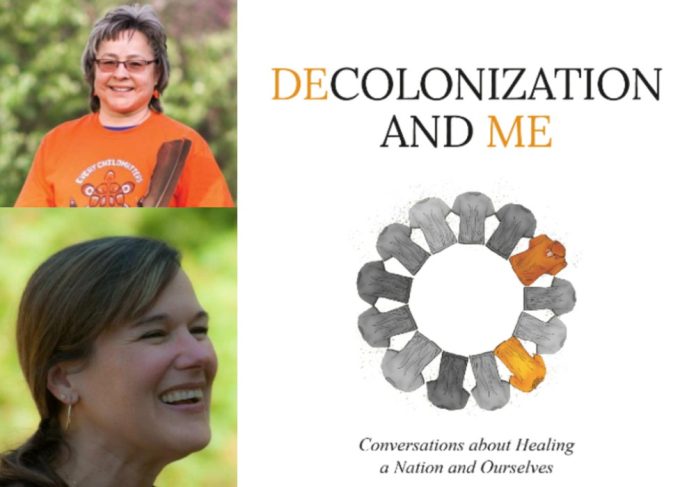
A profound story of understanding and collective responsibility in change.
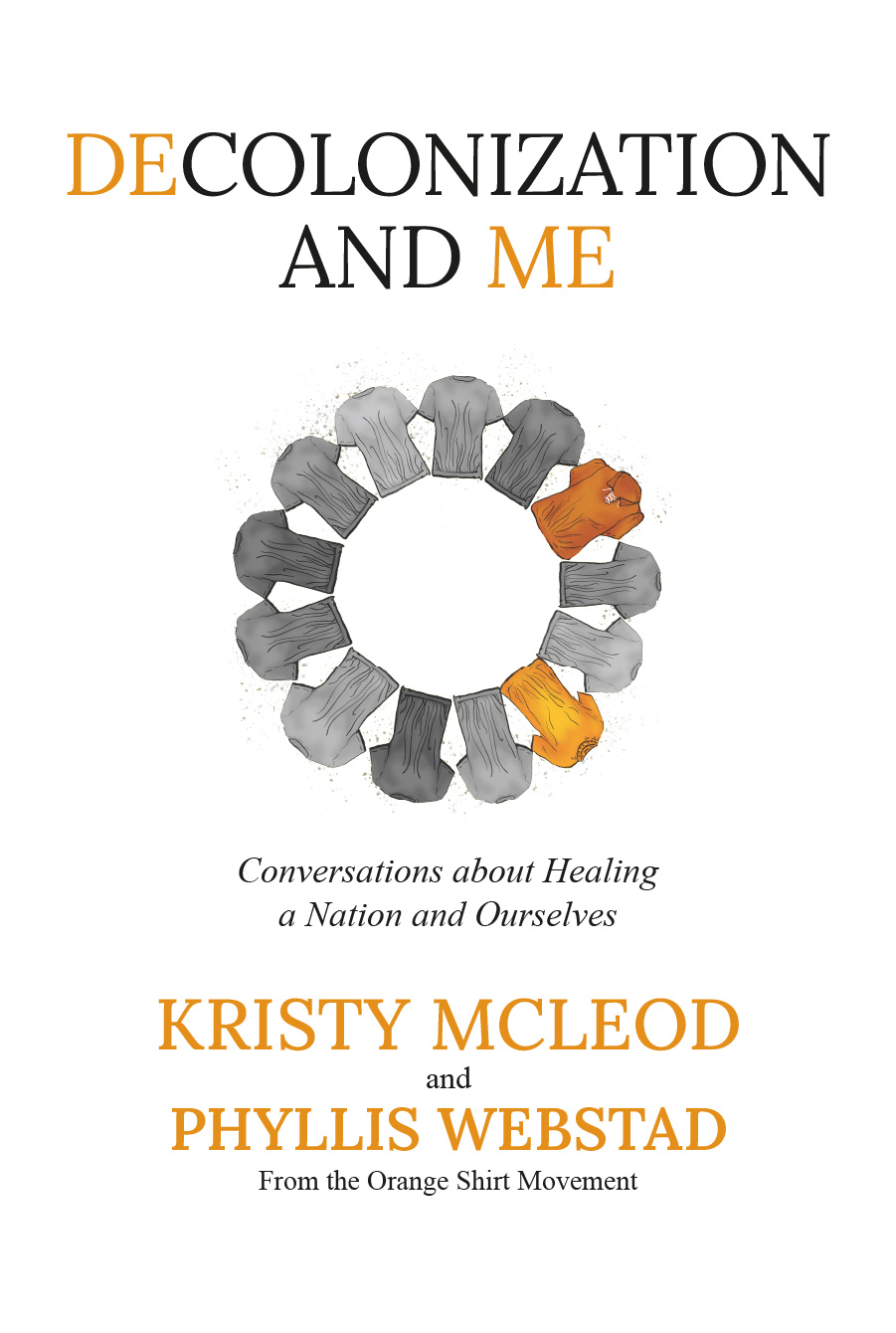
Decolonization and Me: Conversations about Healing a Nation and Ourselves is told with a sense of urgency, inviting readers into sensitive conversations that explore trauma, decolonization and healing via research, reflective questions, truth-telling and personal narrative.
Co-authored by Kristy McLeod and Phyllis Webstad, the book’s release is scheduled for September 1st, in line with this year’s Orange Shirt Day on September 30th—a day of memorial to recognize the multi-generational effects of the Canadian Indian residential school system.
With the book being centred around the Orange Shirt Day movement and National Day for Truth and Reconciliation, it’s an ample opportunity for readers to unpack and reckon with denialism, biases, privilege and what our journey forward may look like.
As readers flip through the book, Webstad—who is a residential school survivor and the founder and ambassador of the Orange Shirt Society—provides insight on these topics, in which co-author and Métis scholar, McLeod, helps further navigate.
Coming up on the novel’s release, Victoria Buzz spoke to McLeod, to discuss her inspiration, her experience writing the book, what truth and reconciliation means to her, and paths necessary for real change.
The beginnings of the book
When asked of inspirations, she mentioned there were a number of things that contributed to her wanting to write. As an educator herself, this included the witnessing of people’s struggles to understand truth and reconciliation within an educational setting, as well as in a government setting.
“I was sitting in on [Métis Nation of Victoria] meetings, I’m a board member…and I witnessed the challenges when systems and governments weren’t truly open to change or struggling to understand what it could look like,” she told Victoria Buzz.
McLeod added that her time working alongside Webstad also served as a catalyst for this novel, as she realized the importance this kind of book would have amongst not only educators and governments, but survivors as well.
“What I saw during that time with Phyllis, is how much of a burden it takes for people like her—surviors in particular—to tell their story. The final [catalyst] was hearing and having to answer to deniers…it’s just so hard on survivors who know the true story.”
Because of these challenges with denialism, as well as the hurt in recalling difficult memories, McLeod and Webstad knew it would be important to take things slow, check in on each other and ensure they had the breathing room to take breaks if needed.
“I like getting out in nature, and surrounding myself with family and friends who understand me and who I could process with. That was key, that’s what got me through it,” she said.
“For Phyllis and I, we both had the full support of Medicine Wheel Publishing, which allowed us to take time when we needed to, allowed us to have complete control over what was and wasn’t included, and they always had our backs.”
For McLeod, her family ended up playing a large part in the completion of the book in addition to providing emotional support. Her daughter, Matti McLeod, assisted with research and her other daughter Ally Webb was in charge of illustrations.
When asked about the process and timeline, McLeod said that she wanted to get this book out as soon as possible, especially with recent news of unmarked graves and witnessing what was happening with politics in some areas.
The idea to write began churning in the fall, and when she sat down to begin writing it in October, it was full-on for months.
“People needed to know, and lots of people wanted to know but didn’t know how to do it, that became the push to get this book out,” she shared.
“It was pretty intense…it’s pretty heavy stuff, and sharing my own personal history with it was hard…but it was really important [to get out].”

Reflection, learning and understanding
As mentioned above, Decolonization and Me includes a number of reflective questions, which McLeod knew would serve as somewhat of a guide for those looking to really understand what’s being said.
“As a teacher I realized that sometimes as learners we get into a ‘passive consume’ mode, and so it’s a practice that I always do: slow down, ask questions, have dialogue and have students write reflections. I saw the value of that,” she said.
By providing these opportunities in the book, she hopes it gives the readers the chance to slow down and help shift those patterns of passive consumption, as they aren’t conducive to change.
“By taking time to reflect on what we’re learning and its relevance to us right after can really help us make meaning of it and create a personal connection to something being learned.”
When asked what McLeod believes is conducive to change, without hesitation she highlighted understanding to be key.
She added that sometimes we might think we understand, but the trouble for many is learning how to actually listen.
“We have to be willing to listen to learn, and enter a conversation with humility…even if [we] don’t agree. Often when we don’t agree we have the most to learn, because there’s so much truth to learn from different perspectives.”
Therefore, when it comes to truth and reconciliation, she added, it’s a path that’s filled with obstacles and challenges that we need to face.
Those challenges take dialogue with people who are open with their hearts and their minds, reiterating the importance of listening to learn, rather than listening to respond.
“It’s not about debate, it’s not about convincing you that I’m right and you’re wrong. It’s about opening up the space to share and understand one another better, and that’s truth and reconciliation for me,” she said.
“It’s an ongoing process…we can’t just jump right to reconciliation, you have to face the obstacles, face the challenges and be uncomfortable.”
Decolonization and Me shares a lot of these uncomfortable truths, and in writing it, pushed McLeod to be a lot more direct in sharing them.
She asks that people approach it with a willingness to be pushed, to read with humility and an open mind, and face the uncomfortable.
“Truth is truth, and the things that happened, happened. It’s not about blame, it’s about recognizing that an injustice was done, and something has to happen to correct it,” she said.
“I really hope this book helps people understand the reason that we all need to be a part of the process, and we all need to be on the path, engaging with truth and reconciliation. Injustice has an effect on all.”
Book launch and what’s next
With the launch, Webstad and McLeod will be going on a book tour around Canada, as well as a couple of launches and school presentations in Victoria.
Munro’s Books will be hosting them on September 23rd at 6 p.m., where Decolonization and Me will be available for purchase.
McLeod will also be presenting at the Cultural Safety Conference alongside other Indigenous women, and that will take place on October 23rd and 24th at the Esquimalt Gorge Pavilion.
This is McLeod’s first book, and as a current PhD student in Curriculum and Instruction exploring Métis Identity, she’s hoping to use part of her dissertation and publish a second book surrounding her research and what she’s learned.
She is a registered Métis with family roots in the Lac St. Anne and Red River Settlements. She has been a teacher for over 20 years, and was chair of the Education Committee for the Métis Nation of Victoria and a Director at Large on its board since 2021.
Webstad is the author of many books, and is the founder and ambassador of Orange Shirt Society. As a residential school survivor, she tours the country telling her story and raising awareness about the impacts of the residential school system.
She is Northern Secwpemc (Shuswap) from the Stswecem’c Xgat’tem First Nation (Canoe Creek Indian Band). She comes from mixed Secwepemc and Irish/French heritage, was born in Dog Creek, and lives in Williams Lake, BC.

If you wish to pre-order Decolonization and Me, you can do so from Medicine Wheel Publishing’s website.
💬 Join the conversation
No comments yet — be the first to start the conversation