

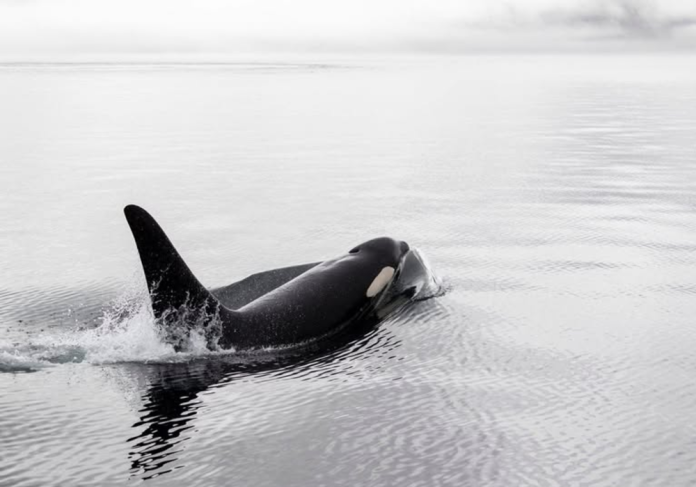
Now, the marine research community is grieving the loss of Northern Resident I76, as some researchers with OrcaLab were following him and his pod the day he breathed his last breath.
On Sunday, August 17th, I76, who is the eldest son of the I4 matriline, was spotted by researchers in clearly visible poor health.
As his pod was venturing through the Johnstone Strait, located roughly between Telegraph Cove and Campbell River, OrcaLab researchers observed that I76 was struggling to keep up with his pod.
It was then that a group of dolphins approached I76, surrounded and overwhelmed him, prompting his mother to come flying across to him.
Those who were there noted that they had never seen a Northern Resident move so fast, and that she must have been in great distress.
Researchers reported that I76’s pod then surrounded him in a tight-knit group, waiting for his final breath.
At around 3 p.m., I76 passed away with his pod surrounding him, and sank beneath the waves. His pod reportedly lingered at the location, calling for some time after he was gone.
Once back on shore, whale researchers gathered at the OrcaLab whale research station to hold a small ceremony for I76.
While holding vigil, I76’s family reportedly passed by the lab headed northbound to Blackfish Sound, while still calling for their lost pod member.
Since I76’s death, marine mammal advocates Strong Coast have raised the question: why was he reportedly emaciated before his death?
Though researchers who followed I76 are still unsure of what specifically caused I76’s death, Strong Coast say they suspect the answer may be related to food supply.
The cornerstone of Northern Residents’ diet is Chinook salmon, but over the past several decades, Chinook populations along the BC coast have sharply declined.
Strong Coast says this is likely due to overfishing, habitat loss, warming waters and pressures from open-net salmon farms.
“With less food available, orcas like I76 can struggle to maintain body weight,” explained the organization in a social media post regarding I76’s death.
At the time of his death, I76 was only around 30-years-old, when Northern Residents can live up to around age 60.
According to the latest data, there are over 300 Northern Resident killer whales left, who roam mainly in waters along the northern half of Vancouver Island, up to southeastern Alaska, with the Johnstone Strait being a key area for feeding.
Conversely, there are only 73 Southern Resident killer whales left, who venture from southern Vancouver Island, all the way down to California.
In addition to advocating for marine mammals off the coast of BC, Strong Coast is a grassroots, community group working to defend the coastal ecosystem from threats such as bottom trawling, poaching and overfishing.