
Vancouver Islanders, tonight’s the night to turn your gaze skyward!
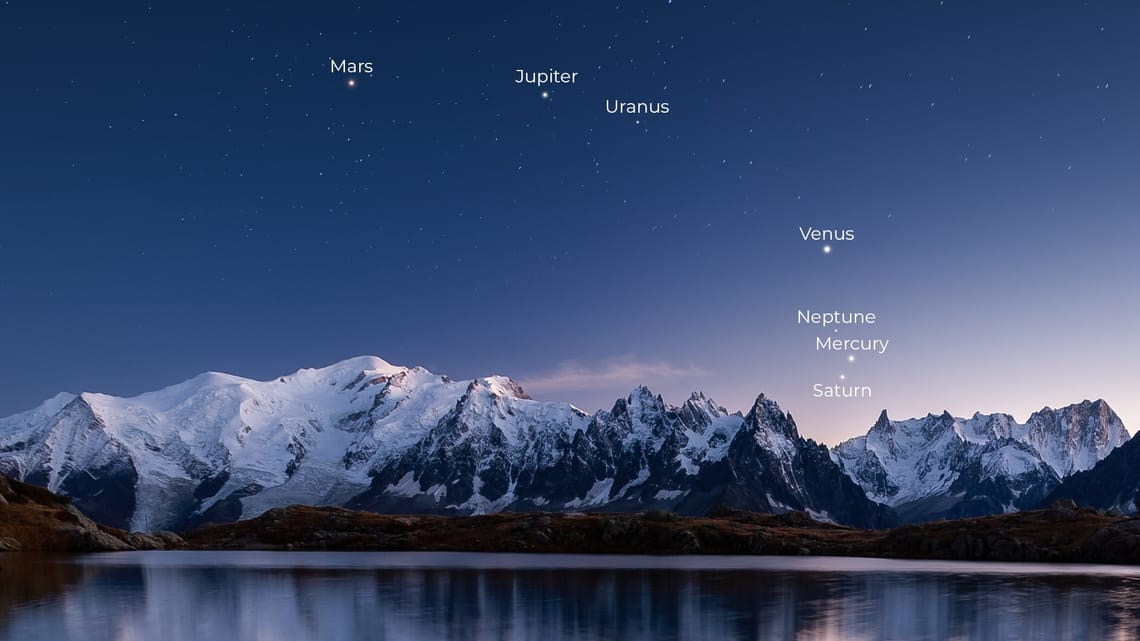
A rare celestial event is set to unfold as seven planets—Saturn, Mercury, Neptune, Venus, Uranus, Jupiter, and Mars—line up in what’s known as a “Great Planet Parade.”
This rare planetary alignment will be visible just after sunset, and if you miss it, you won’t get another chance this decade!
In astronomy, a planetary alignment happens when several planets gather closely on one side of the sun. In this case, seven of them will form a spectacular lineup in the night sky.
While all seven will technically be present, only four—Mercury, Venus, Jupiter, and Mars—will be easily visible to the naked eye. For Uranus and Neptune, you’ll need binoculars or a telescope, and spotting Saturn will require precise timing.
Timing is everything with this event!
The best chance to catch the alignment is shortly after sunset, when the planets will be visible along the western horizon. Because Saturn sets early, the viewing window is short—so don’t wait too long to step outside.
Here’s a quick guide to spotting the planets:
- Mars (reddish and high in the sky) will be in Gemini
- Jupiter (bright and bold) will be slightly lower in Taurus
- Uranus (faint but possible with binoculars) will be near the border of Taurus and Aries
- Venus (the brightest planet) will shine in Pisces, close to the western horizon
- Neptune (very faint, needs binoculars) will also be in Pisces
- Mercury (small but bright) will be near the horizon in Aquarius
- Saturn (the trickiest to spot) will be low in the sky, very close to the sun
The best way to view the alignment is from a dark location with an unobstructed view of the horizon. A free app like Star Walk 2 can also help guide you to each planet.
While some cloud cover is expected to roll in over Vancouver Island, it may hold off long enough for islanders to sneak a look.
If the sky is clear where you are, don’t miss this rare cosmic show!
So, grab a blanket, find a dark spot, and look up—you might just witness one of the most spectacular astronomical events of the decade.
💬 Join the conversation
No comments yet — be the first to start the conversation