

Coming off an Emmy win for Hunt for the World’s Oldest DNA, local filmmaker Niobe Thompson’s latest project on a groundbreaking Canadian scientific discovery will premiere next Tuesday.
Thompson’s film company Handful of Films is based in Victoria and produces many educational and scientific documentaries, but always with a focus on the people behind the science.
In his latest project, Frozen in Time, Thompson spotlights Canadian paleontologist Natalia Rybczynski, her monumental contributions to science and her battle with a traumatic brain injury (TBI) that for a time, cost her everything.
Rybczynski began her career with such enthusiasm, she quickly became a star in the field of paleontology.
However, a series of concussions stopped the scientist in her tracks and prevented her from continuing her research.
Prior to her injury, she made groundbreaking discoveries in the Arctic, such as finding a missing link in the evolutionary chain of the modern seal, the first appearance of dam-building beavers, and discovering that the evolutionary origins of desert camels began in the Canadian Arctic.
Rybczynski was able to discover fossils of a high arctic camel, which had adaptations still seen today in desert camels.
Frozen in Time is a tale of resilience and how Rybczynski never lost her curiosity despite her brain injury.
Thompson says that this project began while he was working on his Emmy Award-winning film Hunt for the World’s Oldest DNA, in which his team interviewed Rybczynski.
“I ended up meeting this woman, Natalia, from Ottawa at the Canadian Museum of Nature,” Thompson told Victoria Buzz.
“We took our Victoria crew to Ottawa to interview her and it was only then that I learned she was actually pretty seriously disabled with the long-term consequence of her brain injury.”
He says for that film, her head injury was not part of the story, but he was fascinated by her resilience and adaptability, so he approached her to ask if she would be interested in telling her story.
Rybczynski has had to find ways to counteract the effects of her TBI in order to pursue her work and even to tell her story. Thompson said he was amazed at the lengths she has to go to, right from her very first interview with his team.
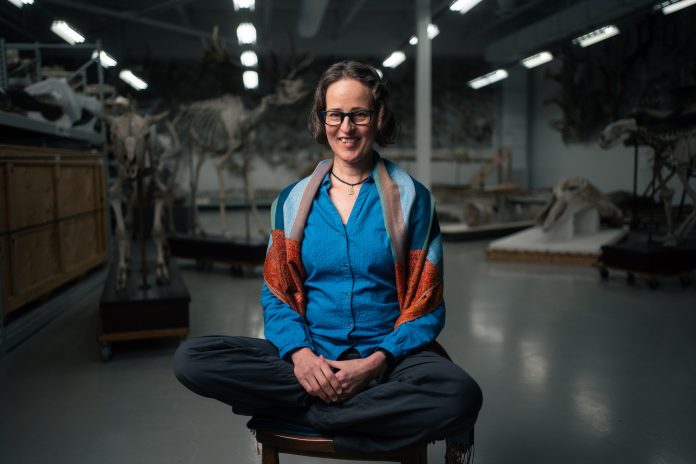
“She sits on a chair with her legs crossed, and the reason for that is she, among other things, can’t really control her blood pressure and her body doesn’t know how to send enough blood to her head,” Thompson explained.
“So she gets faint and gets a foggy mind. So she sits with her legs crossed and wears corsets on her torso, and drinks really salty water just to get enough blood to her brain to sit for a 15-minute interview.”
Her accident occurred in 2011, when she got in a head-on collision while skiing. Following this she was seen by doctors who said it was just a mild concussion and to wait for the symptoms to go away.
Two weeks later, she embarked on an expedition to Antarctica with a group of students and hit a major storm in the Drake Passage which caused her head further damage.
When she came back, her world was changed. Rybczynski couldn’t read, write, drive or even move her body much without excruciating pain, which led to her losing her dream job, and feeling like she had indeed lost her purpose.
However, despite her injury, she eventually persevered and continues to make incredible contributions to the world of science.
Frozen in Time dives into her discoveries and her injury in great depth and detail, telling a compelling story of science and humanity.
The 45-minute documentary film will be premiering on CBC’s Nature of Things, as well as CBC Gem on Tuesday, November 19th.
For those who wish to see the film on a big screen, there will be a preview screening at the Vic Theatre on November 19th as well.
Tickets for that showing are just $12 to cover the rental cost of the theatre.