

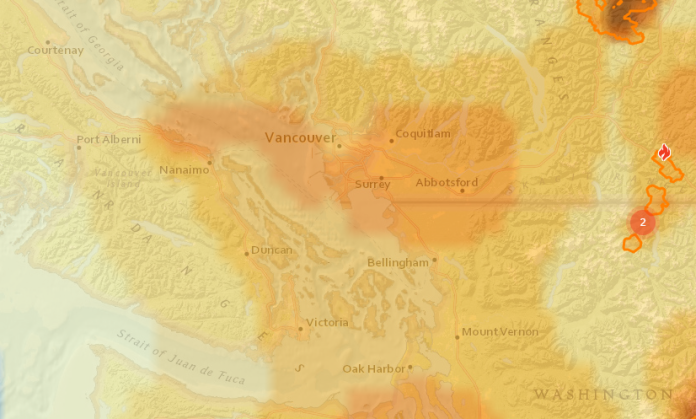
With wildfires burning in Washington and in the southern interior of BC, some wildfire smoke can be expected over Vancouver Island for the remainder of the week and into the weekend.
According to forecasting from Firesmoke.ca, much of Vancouver Island will be impacted by wildfire smoke over the next few days, with the worst of it expected on Friday, August 14th.
Much of the wildfire smoke expected in the region stems from wildfires in Washington, although some will be contributed by wildfires in BC such as the Ainslie Creek and Brunswick Creek wildfires burning just north of Hope.
The two wildfires currently straddle the Trans-Canada Highway on the route between Hope and Lytton and are considered ‘out of control’ by the BC Wildfire Service (BCWS).
There are several other out of control wildfires in the Coastal, Cariboo and Kamloops Fire Centres’ jurisdiction that are also contributing to the smoke that will loom over Vancouver Island.
Currently, Environment Canada’s Air Quality Health Index (AQHI) lists Victoria and Saanich as level 2 on a scale of 11 in terms of wildfire smoke.
A level 2 indicates a low risk to the public, where the general population and at-risk individuals should be able to enjoy the outdoors at their leisure.
As of this publication, the AQHI is forecasting a level 3 between Thursday and Friday evening, which is still considered to be low risk.
Though Environment Canada considers the levels of smoke in the region to be low risk, those travelling to the mainland for the weekend may be more impacted by the smoke and its effects.
As the wildfire situation in BC has become significantly worse over the past week, the Province is urging residents and visitors to take steps to reduce their exposure to wildfire smoke when air quality worsens.
The BC government warns that short-term exposure may cause headaches, irritated eyes, sore throat, coughing and wheezing. Furthermore, exposure can often worsen existing heart and lung conditions.
Long-term smoke exposure can also reportedly contribute to the development of chronic diseases, such as heart disease and dementia.
Those who are at the greatest risk of developing serious acute health effects include people with asthma, heart disease or diabetes as well as people who are pregnant, infants, young children and older adults.
The Province says the best ways to avoid health effects from smoke exposure are to monitor smoke levels, try to keep a clean-air space at home, move activities indoors, reduce the amount of time spent outdoors and wear a well-fitted N95/KN95/KF94 respirator mask to filter air if being outdoors is necessary.
The wildfire situation in southern BC is volatile and can change at any time, so the Province is urging those in the region to be prepared and to keep an eye on air quality in their area.
💬 Join the conversation
No comments yet — be the first to start the conversation