

Lightning lit up the skies over nearly every region of Vancouver Island Saturday night, with repeated flashes continuing throughout the evening.
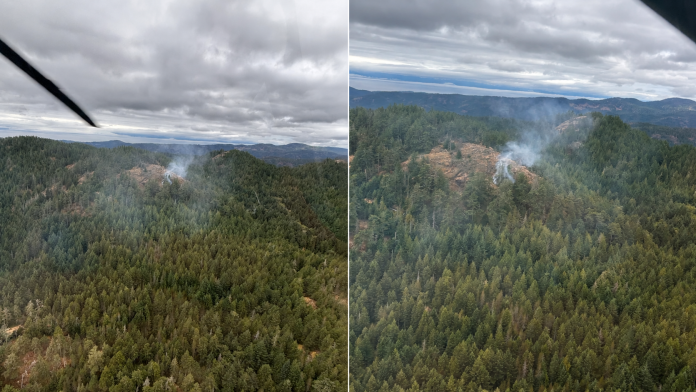
The spectacular storm also carried a serious consequence, with more than a dozen new wildfires appearing on the BC Wildfire Service (BCWS) map following the lightning.
According to BCWS, more than 7,000 lightning strikes were recorded across the province over a 24-hour period as a subtropical weather system brought hot temperatures and widespread thunderstorms.
Lightning-caused wildfires were reported in each of BCs southern fire centres.
Many areas affected by the storm also received substantial rainfall, which helped reduce fire behaviour and the likelihood of some new ignitions.
BCWS said crews and operational staff were prepared for the weather system and that the initial response had been successful, with many of the new fires already classified as being held or under control.
Several fires on Vancouver Island remained classified as out of control Sunday afternoon, although there were no evacuation alerts or orders listed at the time of publication.
An out-of-control designation does not necessarily mean a wildfire is large or immediately threatening a community. It means the fire is continuing to spread or is expected to spread beyond its current boundaries.
The closest active wildfire to Greater Victoria is the Empress Mountain wildfire, identified by BCWS as V61842.
The fire is located near S Jack Lake in Sea to Sea Regional Park, close to the Sooke Potholes area. It was discovered Sunday morning and remained classified as out of control Sunday afternoon.
Empress Mountain is a 682-metre peak and one of the highest points in the region.
BCWS said smoke from the fire may be visible from Greater Victoria and surrounding communities. The cause had not yet been officially listed Sunday afternoon, but the fire was discovered following the overnight lightning storm.
As of approximately 2:30 p.m. Sunday, BCWS listed 179 active wildfires across the province, including 71 new fires reported during the previous 24 hours.
Of the active wildfires, 77 were classified as out of control, representing slightly more than 41% of all active fires.
BCWS data indicated that 150 of the active wildfires were caused or suspected to have been caused by lightning. Eighteen were believed to be human-caused, while another 18 remained under investigation.
There were also 37 evacuation orders listed across BC, but none were located on Vancouver Island. Those numbers are expected to change as crews assess new reports and update existing incidents.
Conditions are expected to become hot, dry and windy again this week, increasing the potential for additional fire activity.
BCWS warned that holdover fires may become visible as the weather changes. These are lightning-caused fires that can smoulder beneath the surface or inside forest fuels without producing visible smoke.
As temperatures rise and fuels become drier, the hidden fires can begin producing smoke or develop into more active wildfires hours or even days after the original lightning strike.
Anyone who sees an unattended wildfire or an unexplained column of smoke should report it immediately by calling 1-800-663-5555, dialing 5555 from a cellphone or using the “Report a Fire” feature in the BC Wildfire Service mobile app.
Photos can also be attached to reports made through the app, but they should only be taken when it is safe to do so.
When reporting a fire, be prepared to provide as much information as possible, including:
- The fire’s location or the direction and approximate distance from a known landmark
- The approximate size of the fire
- What appears to be burning
- The colour and amount of smoke
- Whether flames are visible
- Whether people, homes or other structures may be threatened
- Whether anyone is already attempting to fight the fire
Residents are also encouraged to register for emergency notifications from their local government, discuss evacuation plans with their household and prepare grab-and-go bags before an emergency occurs.
The latest wildfire information is available through the BC Wildfire Service, while evacuation alerts and orders are posted by EmergencyInfoBC.
💬 Join the conversation
No comments yet — be the first to start the conversation