The Union of British Columbia Municipalities (UBCM) is an organization that effectively allows BC municipalities, regional districts and First Nations governments to speak with one voice and communicate their needs to the provincial government in order to operate better.
Every year, the UBCM holds a convention at which members of local governments can meet with BC government ministers, network with one another and learn more about policies that could benefit the communities they represent.
However, the main event of the UBCM convention is the portion where members will decide on what resolutions to endorse, which then provide the Province some direction as to how they can help the many municipalities in BC.
Teale Phelps Bondaroff, District of Saanich Councillor says that although the UBCM serves a lot of functions throughout the year, the convention is the main event for governmental advocacy.
“The annual convention is an opportunity for municipal councillors to debate policy and adopt resolutions. The resolutions we adopt become the core of advocacy work that the UBCM does throughout the year,” Phelps Bondaroff told Victoria Buzz.
“But backing up one step further, UBCM is a union so it speaks with the voice of every municipality in the province. So when we adopt a resolution, it’s not just a letter from Lumby, a missive from Metchosin or an email from Esquimalt.”
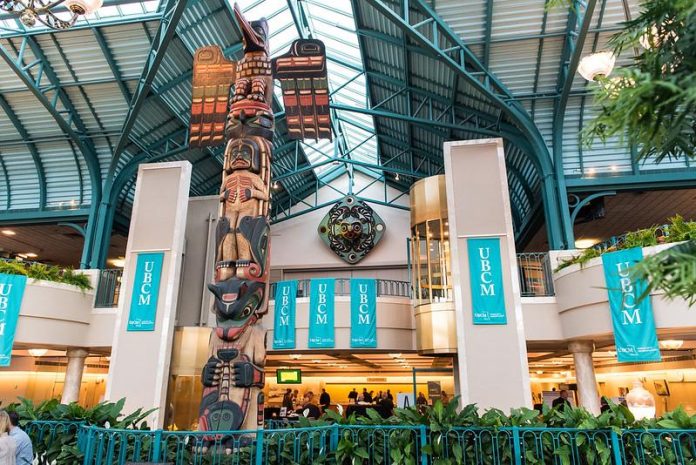
This year, the UBCM convention is being held in the Victoria Conference Centre—the first time the convention has been held in the capital since 2016.
The convention will begin on Monday, September 22nd, and will run through the week until Friday, September 26th.
On Wednesday, the convention will begin the resolution consideration process, tackling, debating and making decisions on all kinds of matters that have been brought forward by the 189 local governments who are members, along with 13 First Nations members.
How the resolutions work
For a resolution to be brought to the UBCM convention, it must have been passed at the local level first. If passed before the deadline, it will be put on the docket at the convention to be considered for endorsement.
At the convention, the resolutions will be brought up one-by-one, with all municipal councillors and representatives in attendance being able to vote.
There are several types of resolutions, which categorize how and when the convention will address each one.
Extraordinary Resolutions (ER) are handled first individually. They are meant to address any necessary amendments to the UBCM Bylaws, or to ask the Province to amend the UBCM Act. There is just one ER to be addressed this year.
Special Resolutions (SR) are addressed next at the convention, as they have been earmarked as priority issues that have heavy impacts on all municipalities in BC. This year there are five SR and they are also considered individually.
The next category of resolutions are the Endorse Block (EB), which are resolutions that already support established UBCM policy. There are 95 EB resolutions, which will be considered all at the same time, because the UBCM has already decidedly supported them. These are basically a reminder to the Province that these issues have still not been addressed at the provincial level, but should be.
Following the EB resolutions are the Not Endorse Block (NEB), which are resolutions that are proposed to the UBCM, but are contrary to existing policy. There are three NEB resolutions on the docket that will be voted on as a block, with the recommendation being to not endorse them.
Finally, there are the No Recommendation (NR) resolutions, which make up the bulk of what will be considered, as they are regarding matters coming before the UBCM for the first time. These are considered individually, with opportunity for members to debate the merit of the matter in front of the entire convention. There are 122 NR resolutions which will be heard if time permits.
According to Phelps Bondaroff, these resolutions can be more powerful if already endorsed by other municipalities and organizations who want to see the same changes made.
There is one more section of resolutions, Referred Resolutions (RR), but they are handled a bit differently, as they have been identified as needing more background information or closer attention due to similar content as existing policy.
Every resolution that will be considered is identified by its category, followed by a number, which determines the order it will be considered in (an example being NR121).
Many municipalities in Greater Victoria have sponsored resolutions to be considered this year: Saanich has nine, Victoria has five, Langford and Sooke each have three, Central Saanich has two and Oak Bay and Metchosin each have one.
To follow along with some of these resolutions and learn more about the process of the UBCM convention, click here for the 2025 UBCM Resolution Book.
Saanich resolutions
Phelps Bondaroff told Victoria Buzz that he is incredibly proud to have penned all of Saanich’s resolutions coming forward this year, with the help of the mayor, his colleagues and some advocacy organizations.
Three of Saanich’s resolutions (EB71, NR100 and NR 102) have to do with BC’s Motor Vehicle Act.
The first (EB71) has to do with allowing municipalities to change the default speed limits on residential roads, where currently it is a costly process that involves seeking permission from the Province.
Presently the default speed limit on residential roads with no centre line is 50 km/h, but Phelps Bondaroff says municipalities should be able to more easily drop this to 30 km/h. This resolution is in the EB, so it has already been endorsed, and will serve as a reminder to the Province on the matter.
Additionally, the second of these (NR100) takes this EB resolution one step further and seeks that the Province just automatically drop the residential street speed limit to 30 km/h, so that individual municipalities won’t have to waste time and money on going through the process themselves.
The last Motor Vehicle Act-related resolution seeks that the Province change the name of the act to the Road Safety Act.
“In British Columbia, we are governed by the Motor Vehicle Act. It governs everything that happens on our roads, except our roads aren’t just used by motor vehicles,” explained Phelps Bondaroff.
One resolution (EB95) that Phelps Bondaroff had some help from Mayor Dean Murdock on, is regarding the creation of a Province-created lobbyist registry which municipalities can opt into. He believes this would increase transparency without putting too much burden on BC’s local governments to create the infrastructure themselves.
There are two Saanich resolutions that have to do with accessibility.
The first is a resolution to push for changes in BC’s Building Code which would all buildings meet a better standard of accessibility, as laid out by the Rick Hansen Foundation (NR41).
The second would align BC with the rest of the world in terms of standards for elevators (NR121).
Another Saanich-sponsored resolution (NR69) is one to do with the Coastal Marine Strategy, which would call on the Province to enshrine the strategy into law to protect marine wildlife along the coast.
The last of the NR resolutions (NR77) that Saanich has put forth is one that would call on the Province to create a humane strategy of dealing with feral rabbits that the District has to deal with frequently, as well as numerous other municipalities.
Though those are all the Saanich resolutions on the docket at this year’s convention, there is one that Phelps Bondaroff hopes will come forward as an emergency resolution.
This matter has to deal with recent talks from Prime Minister Mark Carney regarding the building of another pipeline on BC’s north coast which would increase tanker traffic and be detrimental to the marine ecosystem.
Victoria Resolutions
Victoria’s first resolution to be considered is one to do with housing needing urgent attention from the Province (EB16). This one calls for immediate and drastic action in building new homes where needed.
Next, Victoria sponsored a resolution (NR20) on having the province set targets for supportive housing units included in the housing targets being set for municipalities through the BC Builds initiative.
The last of Victoria’s resolutions in the NR category is one that would allow for more affordable housing units to be built by allocating funds differently (NR25).
Victoria is also supporting two resolutions proposed by other municipalities (RR12 and RR50). The first is the City of Victoria voicing support for establishing housing as a human right, and the second calls on the Province to establish commercial rent control.
Langford resolutions
Langford’s first resolution (NR15) that will be considered has to do with including pelvic floor physiotherapy in postpartum care in BC.
Next, their resolution (NR17) was penned in collaboration with Phelps Bondaroff and supported by the District of Saanich and would call on the BC government to establish that housing be a human right.
Phelps Bondaroff told Victoria Buzz that he and Langford Councillor Mary Wagner are hopeful that this resolution might fundamentally change the Province’s approach to housing policy from the top-down.
“The idea is that when you understand housing as a human right, it reframes how you look at the issue,” Phelps Bondaroff explained.
“Rather than prioritizing profit and money-making ability of properties, you’re actually focussed on serving the needs of people who need housing the most.”
This resolution has also already been endorsed by 9 other municipalities, including Burnaby, Saanich, Langley, Nanaimo, North Vancouver, Port Moody, Richmond, Vancouver and Victoria.
Phelps Bondaroff says he and Wagner had help in pulling this one together from the BC Poverty Reduction Coalition, who will continue to push for this initiative once the dust has settled from the UBCM convention.
Other Greater Victoria municipalities’ resolutions
Sooke has two EB resolutions (EB31 and EB61) which call on the Province for more funding for E-Comm (911 call) services, and that BC includes telecommunications companies in utility tax policies, respectively.
Additionally Sooke has a resolution (NR120) calling on the Province to allow Human Rights Tribunals to take place more quickly, as there is currently a large backlog.
Central Saanich has one EB resolution (EB65) that calls on the BC government for more EV charging stations. They also have a resolution (NR88) that would have the Province allow small, farm-to-table restaurants to be operated from farms.
Oak Bay’s only resolution (NR2) is one that would allow those below 19-years-old to be certified to help with after-school care.
And lastly, Metchosin has an EB resolution (EB37) that would call on the Province to create a strategy to control Canadian goose populations through a cull.
Next week, the UBCM convention will begin and all these resolutions will be addressed.
Once a resolution is endorsed by the UBCM, it will be sent to the BC government and will be dealt with by the appropriate ministries.
According to Phelps Bondaroff, ministers are then obligated to reply with their intentions.
Ministries will oftentimes say that it is a great resolution and that they will work to enshrine it in legislation or policy; however, just as often they will ask for more background information or say that it just isn’t in the cards this year and to try again at the next UBCM.
More details on all these resolutions and more can be found in the 2025 UBCM Resolutions Book.